A LIFE OF PROSE
Australia’s 150-Year Relationship with Afghan Cameleers in Australia
Australia and Afghanistan are two countries separated by vast oceans and disparate cultures. But each country also shares a profound yet overlooked historical connection which spans more than 150 years since the first Afghan Cameleers arrived in Australia.
This relationship didn’t begin via diplomatic exchanges or modern, global trade agreements. Instead, it began with the arrival of a small group of men and their camels on Australian shores in the 1860s.
These Afghani cameleers, as they were collectively known, arrived from across Central Asia, and would become instrumental in opening up Australia’s harsh interior by setting up trade routes, and contributing to nation-building projects that transformed the country.
Fast forward to 25 years ago, and Australian soldiers, like me found ourselves deployed to Afghanistan. It was a poignant twist of historical irony where Australians were now fighting in the ancestral homeland of people who had helped build their nation generations earlier.
Today I would like to welcome you a circular journey across three centuries.
I’d also add that this is not just a fascinating historical footnote, but a complex relationship that continues to affect both countries today.
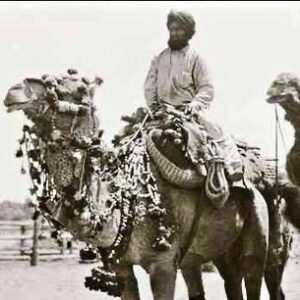
The Arrival: Afghani Cameleers and Their Journey to Australia
The story begins in 1860, when Australia, grappling with the challenges of exploring and developing its vast interior, turned to an unconventional solution.
The harsh, arid conditions of the Australian outback need no introduction; however, even to the toughest of explorers, this region had proven far too demanding for European pack animals like horses and bullocks.
The solution came in the form of camels.
But it was also their skilled handlers—who shepherded these desert-adapted animals—that became pivotal in the early development of Australia, as the country welcomed in the 20th century.
The first officially recorded shipment of camels and their handlers arrived aboard the ship Undaunted at Port Melbourne in June 1860. This initial group of approximately 24 cameleers and their 24 camels would soon be followed by many more.
By the early 20th century, thousands of camels and hundreds of cameleers had made the journey to Australia, fundamentally changing the way the continent’s interior was traversed and developed.
Not Just Afghan: The Diverse Origins of Australia’s Afghani Cameleers
Despite being collectively known as Afghan(i), these cameleers came from a diverse range of backgrounds, and while many did indeed hail from regions of present-day Afghanistan, others came from Baluchistan (now part of Pakistan), the Punjab, Kashmir, Rajasthan, Egypt, Turkey, and Persia (Iran).
They brought with them not just their expertise with camels, but also diverse cultural practices, languages, and religious traditions. These men were primarily Islamic, but the cameleer crews also included Sikh and Hindu handlers.
The term Afghani became a convenient but imprecise label used by colonial authorities and the public, but this over-simplification of their identity would have significant consequences for how these pioneers were perceived, treated, and remembered in Australian history.
Nation Builders: The Critical Role of Afghani Cameleers in Australia’s Development
The impact which the Afghani cameleers—like my Great, great Grandfather George Sher Gul (who featured in my debut novel: Afghani)—had on Australian exploration and the country’s development cannot be overstated, because prior to their arrival, the harsh conditions of the interior had stymied many explorations attempts and made regular supply routes impossible to safely cross.
But the camels, with their ability to carry heavy loads (up to 600 kilograms), and to travel long distances without water, while negotiating arduous terrain, revolutionised inland transport.
Throughout their time, the Afghani Cameleers took up vital roles in many important expeditions, including:
- Burke and Wills expedition (though this ended tragically, it highlighted the potential of camels)
- (Thomas) Elder Expedition of 1891-1892
- Calvert Expedition of 1896
- Carnegie Expedition of 1896-1897
Beyond exploration, Afghani cameleers set up crucial supply lines to remote communities, mines, and pastoral stations.
In many cases, these camel trains were the only reliable connection between isolated outback settlements and coastal cities.
They transported everything from food and water to construction materials, mail, and even prefabricated buildings.
Infrastructure Projects: Building the Foundations of Modern Australia
Afghani cameleers contributed significantly to major infrastructure projects that would shape Australia’s development for generations to come, including:
The Overland Telegraph Line (1870-1872)
This monumental project connected Darwin to Adelaide with over 3,000 kilometres of telegraph wire, linking Australia to the rest of the world. Cameleers transported materials across difficult terrain where other forms of transport failed, carrying telegraph poles, wire, and other equipment essential to the project’s completion.
The Ghan Railway
Perhaps the most enduring symbol of the Afghani contribution to Australia is The Ghan railway.
Named in honour of the cameleers (though the name wasn’t officially adopted until 1929), this railway line originally ran from Port Augusta to Alice Springs. The Afghani Cameleers were crucial during its construction, transporting materials and supplies to work crews along the route.
Today’s modern Ghan railway, which now extends all the way to Darwin, stands as a physical monument to the Afghani contribution to Australia’s development.
Mining and Resource Development
The Australian gold rushes and later mining booms relied heavily on camel transport.
Afghani cameleers delivered equipment and supplies to remote mining sites and transported the extracted resources back to processing facilities and ports. They were particularly vital to the Western Australian goldfields, where water was scarce and traditional transport methods were often ineffective.
Life in a New Land: Culture, Community, and Discrimination
The Afghani cameleers brought their Islamic faith with them to Australia and set up the continent’s first mosques and prayer rooms.
The earliest of these was a simple structure built in Hergott Springs (now Marree) in 1861. More substantial mosques followed in:
- Adelaide (1888)
- Broken Hill (1891)
- Perth (Little Syria, 1904)
- Coolgardie (1896)
These mosques became important community centres for Muslims in Australia, places where faith could be practiced and their cultural ties maintained. They are the beginning of Islamic history in Australia, predating larger waves of Muslim immigration by decades.
Ghantowns: Communities and Social Life
As their numbers grew, Afghani cameleers set up their own communities, often referred to as Ghantowns, on the outskirts of established settlements.
These neighbourhoods typically included a mosque, specialised shops, and residencies.
Major Ghantowns developed in Marree, Broken Hill, Coolgardie, and Port Augusta.
Social life in these communities revolved around religious observances, traditional customs, and the camel business. However, the demographic reality—as most cameleers either arrived in Australia as single men or were forced to leave their families behind—created significant challenges. This was especially because colonial authorities rarely permitted cameleers to bring their wives or families to Australia, leading to profound isolation for many cameleers.
Some cameleers married or formed relationships with Aboriginal or European women, creating multicultural families, which ultimately created new, but long-lasting cultural connections, like the descendants of the Australian Muslim Cameleers.
These relationships were met with significant social disapproval and legal obstacles, at the time, but nonetheless they still formed an important part of Australia’s developing multicultural identity.
White Australia Policy and Decline
The implementation of the Immigration Restriction Act of 1901 (the foundation of the White Australia Policy) dealt a severe blow to cameleer communities and the policy often restricted non-European immigration and made it extremely difficult for existing cameleers to bring family members to Australia or to return to Australia if they traveled home to visit relatives.
Additionally, because of technological changes, and particularly the introduction of motorised transport in the early 20th century, the demand for camel transportation fell into a significant decline.
By the 1920s, the cameleer industry had all but disappeared, and many of the Afghani either returned to their homelands or moved to coastal cities seeking other employment.
Yet despite these challenges, some cameleers also adapted by transitioning to new businesses or finding niches where camels remained useful. Others proved themselves of worth in different industries, including retail businesses that served remote communities.
Legacy in the Landscape: Enduring Marks on Australia
The Afghani presence has left permanent marks on the Australian landscape through many place names and landmarks, including:
- The Ghan Railway (named after the Afghan cameleers)
- Ghantown Creek near Marree
- Afghan Hill in Coolgardie
- Mosque Hill in Cloncurry
- Numerous Afghani Wells and Camel Wells across the outback
These toponyms serve as permanent reminders of the Afghani contribution to Australian development and history.
Architectural and Cultural Heritage
Several mosques built by Afghani cameleers still stand today, including the heritage-listed Marree Mosque.
Museums in former cameleer centres like Broken Hill and Alice Springs preserve artefacts, photographs, and stories from this era. The Afghani architecture of these mosques, which featured distinctive domes, minarets, and decorative elements all introduced new aesthetic influences on the Australian built environment.
Biological Legacy: Australia’s Feral Camel Population
When the camel transport industry declined, many camels were released into the wild—because their handlers refused to kill them.
These animals thrived in the Australian outback, creating what is now the world’s largest feral camel population—now estimated at over 1 million feral camels.
This population, while presenting environmental management challenges, stands as a living reminder of the cameleer era.
From Historical Contribution to Military Engagement: The Modern Era
For many decades, the contribution of Afghani cameleers to Australian development went overlooked in mainstream historical narratives. However, beginning in the 1980s, historians, community groups, and descendants of cameleers began working to rectify this omission.
Important milestones in this recognition include:
- The establishment of the Ghan Preservation Society in Marree
- Publication of scholarly works on cameleer history, including Australia’s Forgotten Pioneers by Christine Stevens
- Creation of museum exhibits dedicated to cameleer contributions
- Formal recognition through heritage listings of cameleer sites
- Inclusion of cameleer history in educational curricula
This growing recognition of the Afghani contribution to Australian history provides vital context for understanding Australia’s later military involvement in Afghanistan.
Australia’s Military Engagement in Afghanistan (2001-2021)
In a profound historical irony, Australian forces were deployed to Afghanistan, as a response the September 11, 2001, terrorist attacks and because the Taliban harboured Osama Bin Laden.
Operation Slipper, Australia’s military contribution to the International Security Assistance Force (ISAF), represented the nation’s longest war, lasting from 2001 to 2021.
During this 20-year engagement:
- Over 39,000 Australian Defence Force personnel served in Afghanistan
- 41 Australian soldiers lost their lives
- Hundreds more were physically wounded
- Thousands continue to deal with psychological impacts, including PTSD
- Over 1600 soldiers, sailors and airmen have taken their own lives as a direct result of war wounds.
The Australian mission evolved over time, shifting from direct combat operations against Taliban and Al-Qaeda forces to training and capacity-building with the Afghan National Army and Police. Australian Special Forces, including the Special Air Service Regiment (SASR) and Commandos, played particularly significant roles in the conflict.
Cultural Understanding and Historical Parallels
The historical connection between Australia and Afghanistan provided a unique perspective for some Australian military personnel.
Soldiers, like me who were aware of the cameleer history sometimes found it offered valuable context for understanding the cultural landscape we were encountering.
Some military units even incorporated historical knowledge of the early Afghan Australian connection into their cultural awareness training.
For Afghan Australians, including descendants of the original cameleers (I’m potentially the only one who served as a soldier in Afghanistan), as well as more recent immigrants, the Australia’s military involvement in Afghanistan created complex emotions. However, many of us supported the efforts to combat extremism while maintaining a deep concern for the civilian impacts and hoping for a stable, peaceful future for Afghanistan.
Contemporary Connections: The Afghan Australian Community Today
The descendants of Afghani cameleers have integrated into contemporary Australian society while supporting the connections to their heritage.
Family names like Akbar, Khan, and Mahomet continue the legacy of these pioneers.
Organisations such as the Afghani Cameleer Heritage Association work to preserve and promote awareness of this history.

Recent Immigration and Refugee Resettlement
Afghanistan has been a significant source of refugees to Australia, particularly following the Soviet invasion (1979), the Taliban’s rise to power (1990s), and the more recent instability.
The Afghan Australian community now numbers over 100,000 people and makes important contributions to Australian society in fields including business, education, arts, and public service.
Cultural Exchange and Understanding
Cultural exchanges between Australia and Afghanistan have increased in recent decades, including:
- Educational partnerships between universities
- Humanitarian and development projects
- Sporting connections, including cricket diplomacy
- Arts and cultural exhibitions
- Business and trade relationships
These exchanges build upon the historical connection set up by the cameleers and show how the relationship between the two nations continues to evolve.
Conclusion: A Relationship Comes Full Circle
The 150-year relationship between Australia and Afghanistan is a remarkable historical narrative of connection, contribution, and complexity. From the arrival of those first cameleers who helped build a nation to the deployment of Australian troops in Afghanistan, the two countries have been linked in ways that transcend geopolitics.
As Australia moves on from its operations in Afghanistan and the Afghan people continue their struggle for stability and self-determination, the historical connections between these two nations provide valuable perspective. The legacy of the Afghani cameleers reminds us that cultural exchange and migration have shaped Australia’s development in significant ways, creating connections that last for generations.
Understanding this shared history offers opportunities for deeper cultural understanding, recognition of historical contributions, and perhaps most importantly, a foundation for future relationship-building based on mutual respect and appreciation of our intertwined past.